BLS+CPR for Healthcare Providers
Choking
A person chokes when the airway is partly or completely blocked and airflow to the lungs is reduced or cut off. The choking casualty either has trouble breathing or cannot breathe at all.
|
Causes of Choking |
||
|
Foreign objects |
Tongue |
Swelling |
|
Infants and children (food, toys, buttons, coins, etc.) |
Tongue falls to the back of the throat when lying on back |
Injury to the throat area causes swelling of the airway |
|
Adults (consuming drinks quickly with food in their mouths) |
Saliva, blood, or vomit pools in the throat |
Illness causes swelling (e.g., allergic reaction, asthma, epiglottitis, croup) |
|
Elderly (food, pills, etc.) |
Swollen airway |
|
With good air exchange, the obstruction is mild and the casualty can still cough forcefully, breathe, and speak. With poor air exchange, the obstruction is severe and the casualty cannot cough forcefully, has trouble breathing, or cannot speak. With a completely blocked airway, there is no air exchange. It is impossible for the casualty to cough, breath, or speak.
When the air supply to the lungs is cut off, the casualty’s face immediately becomes red or “flushed.” Shortly after, as the oxygen in the body is used up, their face becomes grey and the lips and ear lobes become blue. The casualty then becomes unconscious and eventually the heart stops beating.
|
Signs of Choking |
|
|
Mild Obstruction |
Severe Obstruction |
|
Able to speak |
Not able to speak |
|
Signs of distress (eyes show fear) |
Signs of distress (eyes show fear) |
|
Forceful coughing |
Weak or no coughing |
|
Wheezing and gagging between coughs |
High-pitched noise or no noise when trying to breathe |
|
Red or “flushed” face |
Grey face and blue lips and ears |
First Aid for Choking for an Adult or Child
To give first aid for a choking adult or child, perform the following steps:
1. Perform a scene survey.
2. If the casualty can cough forcefully, speak or breathe, tell them to try to cough up the object. If a mild obstruction lasts for a few minutes, get medical help.
3. If you think there might be a severe obstruction, check by asking, “Are you choking?” If the casualty cannot cough forcefully, speak or breathe, use back blows followed by abdominal thrusts to remove the blockage.
- Give back blows and abdominal thrusts:
- Support the casualty and give up to five blows between the shoulder blades using the heel of your hand.
- If the obstruction is not cleared, step behind the casualty, ready to support them if they become unconscious.
- Make a fist, place it on the casualty’s abdomen at the belly button, in line with the hip bones. Grasp one fist with the other hand and give five forceful inward and upward abdominal thrusts.
- If the object is not removed, repeat back blows and abdominal thrusts.
4. If the casualty becomes unconscious:
- Lower them to the ground. Call for medical help and get an AED if available.
- Begin chest compressions immediately. After the first 30 compressions, check the mouth. Remove any foreign object you can see. Try to give 2 breaths. If air does not go in, continue to give chest compressions and inspect the mouth before ventilations.
First Aid for a Casualty who is Pregnant or Larger than the Rescuer
If a choking casualty is larger or is pregnant, give back blows as normal, followed by chest thrusts.
- While supporting the casualty, give up to five back blows between the shoulder blades, using the heel of your hand.
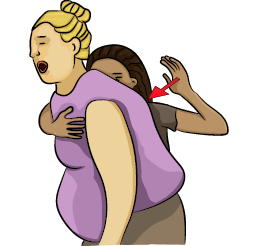
- If the obstruction is not cleared, stand behind the casualty.
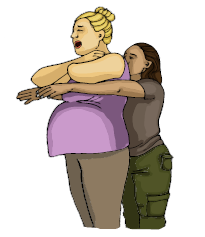
- Keep your arms horizontal and snug up under their armpits.
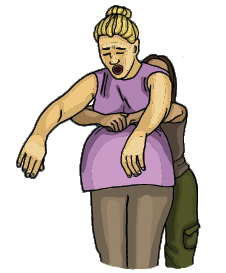
- Place your fist against the lower half of the breastbone, thumb- side in.
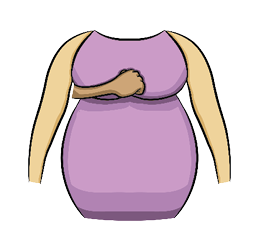
- Hold your fist with your other hand. Pull inward forcefully.
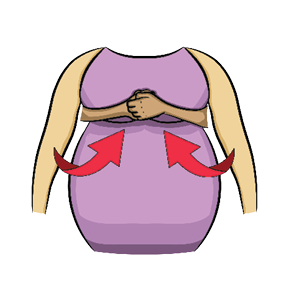
- Continue giving back blows and chest thrusts until either the object is removed, or the casualty becomes unconscious.
First Aid if you are Alone and Choking
If you begin to choke on an object, you may have to clear your own airway.
- If there are people around, get their attention. Do not isolate yourself from others.
- Try to cough up the object.
- Give yourself abdominal thrusts until you can cough forcefully, breathe or speak.
A second method is to use a solid object like the back of a chair, a table, or the edge of a counter.
- Position yourself so the object is just above your hips.
- Press forcefully to produce an abdominal thrust.
How abdominal thrusts work
When you choke on something, your body tries to unblock your airway by coughing. Abdominal thrusts try to do the same thing with an artificial cough. This illustration shows how an abdominal thrust creates a cough.

An abdominal thrust quickly pushes the diaphragm up towards the lungs. This forces the air from the lungs up the airway and hopefully blows the obstruction out. For the best effect, the fist must be in the correct place. Keep your forearms off the abdomen and make each thrust a strong and sudden movement.

First Aid for a Choking Casualty in a Wheelchair
Some wheelchairs will allow the first aider to provide abdominal or chest thrusts as they would for a casualty who is standing.
If you can reach around from behind the wheelchair, give back blows as normal, and abdominal or chest thrusts.
If you cannot reach around the wheelchair:
- Position the wheelchair against a wall (if possible) and place the wheelchair brake on.
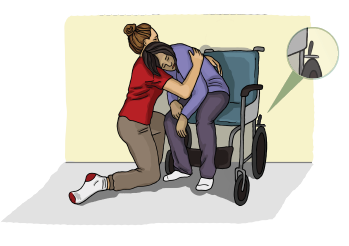
- If possible, carefully lean the casualty forward and support their shoulders. Perform five back blows between the shoulder blades, using the heel of your hand.
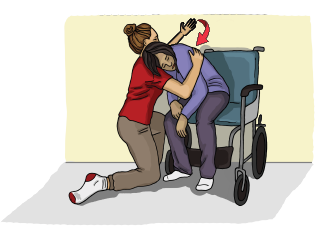
- Put the heel of one hand, with the other on top, on the centre of the breastbone and give firm chest thrusts.
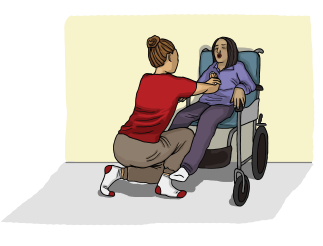
- Repeat back blows and chest thrusts until the object is removed or the casualty becomes unconscious.

If a doctor, physiotherapist, or other health professional has shown you a different way of giving abdominal thrusts to a person in your care, use the recommended method.
If the casualty becomes unresponsive, you will need to take them out of the wheelchair.
- Call for medical help and get an AED.
- Pull the casualty forward supporting them as best as you can and lower them to the ground.
- Roll the casualty to the floor to a face up position.
- Begin chest compressions immediately. After the first 30 compressions, check the mouth. Remove any foreign object you can see. Try to give 2 breaths and continue to give chest compressions and inspect the mouth before ventilations.
First Aid for a Choking Infant
An infant is choking when they suddenly have trouble breathing, start coughing or gagging, and have high-pitched, noisy breathing.
- Perform a scene survey and primary survey.
- If the infant can cough forcefully or breathe, let the baby try to cough up the object. If a mild obstruction lasts for more than a few minutes, send for medical help.
- If the infant cannot cough forcefully, cannot breathe, makes a high-pitched noise when trying to breathe or starts to turn blue, begin back blows and chest thrusts.
- Secure the infant between your forearms and turn them face down.
- With the infant’s head lower than the body, use the heel of your hand to give five forceful back blows between the shoulder blades.
- Turn the infant face up and give five chest thrusts.
- Keep giving back blows and chest thrusts until either the airway is cleared or the infant becomes unconscious.
- If the infant becomes unconscious, send for medical help. Begin chest compressions immediately.
- After the first 30 compressions, check the mouth. Remove any foreign object you can see. Try to give 2 breaths and continue to give chest compressions and inspect the mouth before ventilations.
 |
 |